Monday, August 12, 2013

Am I the physical or am I the essence

This spawned from a discussion thread on a Google+ community today.  Someone posted the question, "If Life decomposes & redistributes the material to be used again in some other form or forms, is there any such thing as death?"  Which sparked a great deal of thought on my part as to whether I am truly the physical form in which I reside, or if I am just the thoughts imprinted on my essence through my experiences.  My physical form is important, but is it really more than a vessel.  Is it more than just a vessel carrying something greater? Is my essence truly greater?

I firmly believe that my essence belongs to me. It is, after all, my experiences that have been imprinted upon it.  In a recent post (Man vs. Machine Part 1) I refer to the difference between the brain and the mind, in comparing to a computer.  In that post I wrote:

When I think of the brain, I think of the actual organ, not the mind, not our personalized spin on things.  The mind is more like the software stack than the CPU, it takes our own experiences and adds interpretation onto what the brain is processing.

This is at the heart of what I'm getting at here today.  Without our mind we are nothing.  I see the mind and soul (or essence) as one.  However, the real question remains: "What is our essence".

Some people believe that we are mere extensions of a greater god being.  We are part of this god, and so is every other living thing.  The belief also stands that we are experiencing for a god whom is incapable of experiencing these things for itself.  If this were considered truth, would this mean our essence is the part that binds us to this God?

Upon our demise is this essence rejoin God, and perhaps return again later - as suggested by the ideas of reincarnation.  Could it be that instead, we do simply cease to exist.  Our body takes our soul with it?  If our body were reincarnated without the mind would it matter?  Would that reincarnated being still be you?   Would the mind without the body still be you?

I believe that our image of our "self" is imprinted on the mind, and while elements may fragment and change if the body is destroyed, it seems conceivable - at least to me - that the preservation of the mind preserves ones self.

Sunday, July 28, 2013

Man vs. Machine (Part 1 - Similarities)

I am a computer software engineer.  I understand computers to a degree that most people do not.  I understand what takes place, inside the machine, to make the magic happen.  This is something that I've spent most of my life immersed in, it is a non-stop learning experience to write software.  Every time you turn around there is something new to learn.  However, the fundamental truth is that the core workings remain the same.  Moreover, I have come to find that those core workings of the machine resemble our own.

While they are not perfectly humanistic (yet) the basic model is highly similar.  Perhaps this was on purpose, or it was just the natural evolution of technology.  The best way to explain my point is probably through a simplistic example.   Note, this is a high level example.  For the sake of brevity and entertainment, I have omitted or briefly touched on some of the specifics.  


Example: Input, Processing, Storage, and Output.
A keyboard, mouse, fingerprint reader, microphone, etc. are all input devices, and they respond to the touch of the user, or the sounds in the environment, or in some scenarios data that comes in from a variety of sensors.   These input mechanisms represent the 5 human senses (touch, taste, smell, sight, and sound) although they manifest in different forms for a computer, again the core mechanics are quite the same.

The signals from our senses are transferred through our bodies using our nervous system.  The nervous system is akin to the System Bus in a computer.  This is simply a path by which data travels from the various ports on the machine to the CPU for processing, and from the CPU to the output devices.   The CPU is pretty much the brain of the machine.  

Our brain processes data at amazing speeds, because of this - with little thought - we can throw a ball at an arc to put it through a basket 10 feet away, judge the angle required for a golf shot to get within a few feet of the hole, or bounce a cue ball off the rail to sink the 8 ball.  Similarly a CPU can churn through the data coming from the various input devices at blazing speeds to tell the operating system and software (call it the software stack) what to do with it.

When I think of the brain, I think of the actual organ, not the mind, not our personalized spin on things.  The mind is more like the software stack than the CPU, it takes our own experiences and adds interpretation onto what the brain is processing.   Much in the way that the operating system and application software add interpretation about how to handle a key press event, mouse click, or voice command.  The responses to some of these events can be tailored, by settings that we can change.  Just as we can control our responses to certain stimuli, but not so much to others.

As we are processing data in this manner, it is being retained in short term memory.  So we can hang onto it briefly but then just discard it later.  Again, computers do this same thing using RAM.  It is quite explicitly volatile memory designed to allow the machine to discard it when it's done with it.  Only persisting what the software (mind) deems appropriate to remember to non-volatile storage media such as a hard disk (long term memory).

Later we may tell stories of events that went through this process described above and share it with others, offering them - if they are listening - a window into our world, how we think and feel about things, and how we interpreted that story.  We recall it by reaching into our long term memory and reading it up, just like a file from a hard disk.  We share the story by writing it out, speaking it, or even creating media to help visualize it.  This final piece is representative of the computer's output mechanisms - monitors, speakers, printers, etc.

In the near future I'll publish some differences, the big one of course being binary logic vs. human logic, and expand on things by discussing some programming structures and how those compare to human traits as well.

Saturday, May 11, 2013

In an instant...

Today my mother and my daughter went out for a short walk   When they returned my child presented my wife and I each with a wildflower she'd picked for us.  I struggled, but could not recall the name of the flower I'd picked so many times as a child.  Nevertheless, it invoked a very strong sense of nostalgia for me.  It forced me to think back to all those many years ago when I was growing up.  It prompted me to consider moments spanning nearly two decades of my life.  There, in an instant, they were recaptured, but only to dissipate almost as quickly.


How symbolic must this plant, fleabane, be to me.  Why do violets, dandelions, and for that matter clover, not have the same value to me.  Words cannot truly express how powerful an experience this was. I had memories of loved ones long gone; experiences with friends that I've not spoken to in many years; stepping on chestnut hulls with bare feet; swinging in the backyard on a hammock, where the trees that held it have been cut down for nearly 3 decades; swinging on my swing set, thinking I saw someone out of the corner of my eye, but finding that no one was there; playing in the creek with my cousin; playing in the pool with the same cousin; my grandpa asking me about things I'd drawn; my family gathered on the porch talking for hours on end about "grown up things", and me wishing I understood and could participate.  All of this came, and left, in an instant.


My family is very close, and for that I am thankful.  My mom and dad live next door to the house where his parents lived, and where he grew up.  Behind them the younger of my older brothers, and behind him my aunt.  Within a few hundred yards are two other aunts, and a few member of my more distant family.  When I was a child I would spend much of my time playing between houses.   As for the expression "It Takes a Village", it did, but luckily I had one.

From time to time I do stop and feel a lot of regret, regardless of how I tell myself that there is no need to waste time looking back.  If only I'd understood those conversations on the porch with the grown ups.  If only I had listened to the advice of my family.  If only I'd known then, what I've come to know now.  I'd have played parts of my hand differently for sure.

Don't misunderstand, I love who I've become.  I also know that I would have never become this guy that I am today without the decisions I made, and their respective consequences. Nevertheless, if I had the chance at a do-over, I'd cherish the moments more and embrace my loved ones longer.  I would have asked more questions about the "old days" and listened more to the nuggets of wisdom my grandparents would have loved to share.  Because, if there is nothing else I've learned in life, it is to love and be loved because it can all be over in an instant.

Monday, April 22, 2013

Anti-Christian Christianity

Slowly I'm coming to realize that my problem with Christianity is not the religion.  It's not the story of Jesus himself.  It's not the fact that the matter of biblical canonization was... questionable.  It has little to do with the fact that there are so many different versions of the bible, that you really need a BA in history to fully understand what the reasons are behind each.  Nor is it the fact that there are so many different denominations of the Christian religion across the world that practice in such different ways that it's hard to say, in today's world, what Christianity truly is.  The real reason I have a problem with Christianity is... Christians.

“I like your Christ, I do not like your Christians. Your Christians are so unlike your Christ.” - Ghandi. 

Don't get me wrong, I have known some fantastic folks who follow Jesus.  In fact some of my best friends are very devout Christians.  However, the majority of Christians in America, in this day and age, certainly appear to miss some of the things that I consider explicitly defined in the text of the bible we have.

I firmly believe that the Jesus in the bible, living today, would support social programs and universal healthcare.  He would not deny happiness of anyone. While he would know if it were a choice for them, in absence of that knowledge he'd still give the benefit of a doubt - instead of assuming they were "choosing" to be ridiculed and different.  He would not fill his closet with furs and hang gold and diamonds from his ears and neck.  He would not drive a car that costs more than a minimum wage worker's annual salary.

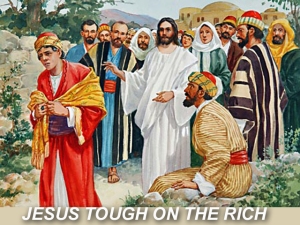
Unfortunately, I feel that many of today's Christians would disagree with me on all of the points above.  Regardless of the fact their most important book, the Holy Bible, the supposedly infallible word of God, would tell them to take their riches and give them away to receive their reward in heaven.  It saddens me that we live in a world filled with the self-righteous and pious who would besmirch and bastardize something as good and pure as the teachings of Christ.  However, I guess that is the way it has always been, and will continue to be.

Friday, April 19, 2013

Heads I win, tails you lose

In general I believe that we humans have a desire to do what is right, or at least what seems right to us.  The notion that there is an explicit good and an explicit evil is in my mind a fallacy.  To deny the knowledge of evil would would render the good imperfect.  To admit the knowledge of evil, means the good truly knows the evil.  Either way, the good is imperfect and thus impure.  The inverse could be said of evil, a knowledge of good is required to be evil.  This is essentially the Taoist concept of yin and yang.


There is an old saying, that every coin has two sides.  Or as another states it, there are two sides to every story.  While we echo these expressions like parrots we seldom stop to consider their implied meanings.  They simply indicate that looking only at the surface reveals an act of pure good, or a heinous act of evil.  However, somewhere deeper you see that it's not so cut and dry.

Consider a man (lets call him Dave) who kills his brother (Mike), who came to confront him over an issue they'd been having.  Things escalated and Dave, the younger of the two, pulls out a gun and leaves a slug lodged inside the cranium of his closest kin.  A life is taken, and a young man spends his life behind bars.  Deservedly so, he is insane to resort to such an act of violence so quickly.  

Dave has committed an unspeakably evil act.  He was unreasonable and reacted so unexpectedly and with such furor that elder brother - who'd only come to talk - now lays prone on the dirt ground with a fairly large entry wound on his forehead.  Dave deserves severe punishment for such an act.

Except...  Mike had been making threats against his wife and children, and both men knew he was planning to carry them out.  That was the reason for the altercation, and the resulting action.  However the only two who know this are the deceased, and the one who was absolutely guilty of the murder.  He is imprisoned, but his family is now safe.

Who is the bad guy and who is the good.  Would you believe his defense?  Would you have leniency if you did?  Even in this very simple example, the lines are now blurry once you know the rest of the story.  This applies to many things in life - except we never get to know the rest of the story.   Humans for all of our values, have a tendency to make harsh and rather rash judgement against our fellow humans.  We are all-too-often ready to condemn, in spite of the fact that only a part of the story is known.  I know that if we could somehow drop the shoot (off at the mouth) first ask questions later mindset, we could find the deeper answers in so many things.


Thursday, October 11, 2012

Politics, Religion, and The United States of America

I love being a citizen of a country where people have the right to say what they want to say, do pretty much anything they want to do, and make a better life for themselves through hard work and sacrifice.  A country where we elect our leaders, and can alter the system anytime we see fit.  However there is a political shift in this country, and I believe it has the strength and desire to disrupt this country and change what America truly represents.

Many people will quickly point out that this country was founded on religion, which I don't entirely dispute. However, when talking about the founding of this country a good history lesson will tell us pretty quickly that it was more about running away from the tyrannical hand of combined church and state in England. 

Since we no longer allow much in the way of religious discussion in our classrooms -- in this pinnacle of freedom, it may not be so obvious what this all means.  So here is a quick history lesson.  In the early-mid 1500's during the reign of King Henry VIII of England, there was a rift between the King and Pope Clement VII.  At the time Catholicism was the Christian religion.  The reformations that brought about protestant religions had not yet started.  Around this same time Martin Luther was discovering what he considered to be atrocious behavior by the church and published his 95 theses.  

Henry wanted a divorce from his first wife -- most of that part of the story is well known -- and was willing to do pretty much anything to make it happen.  He also had some religious reformists serving on his privy council.  This culminated in the rising of the Church of England, which was essentially forced upon you if you lived in England - you could opt for a beheading instead like Sir Thomas More.  Meanwhile reform was afoot elsewhere by the followers of John Calvin and Martin Luther.

Fast forward now to the first born daughter of Henry VIII, who would eventually become Queen of England.  She earned the nickname Bloody Mary because of the slaughter that took place in the name of converting England back to Catholicism (nearly 300 burned at the stake for heresy in only 5 years).  Upon her death, her sister, Henry's other daughter Elizabeth came to power and brought peace back to England and the Anglican Church.  It was King James (yes that King James, of  Bible Version fame) who was Presbyterian, and rejected much of the "purification" philosophies of the reformers, who finally pushed the Pilgrims over the edge and prompted them to leave England.

So, the Pilgrims left England to escape the combination of Church and State (King James and the Church of England).  The Puritans were Calvinists, and they were angry with King James as well, so they broke rank for pretty much the same reasons.  The rest of the settlers starting with Jamestown (i.e. King James' Town) were sent here by England to colonize the new land.  This was all about colonization, and had nothing to do with religion.

So when someone says this country was founded on religion, bear in mind it was very much founded on FREEDOM OF RELIGION, which should not be confused with a specific religion itself.  If you want to go down that road, it was certainly not any denomination that would hoist the King James Version of the Holy Bible proudly into the air.  

History should tell us that we do not want to go down the road of faith-based legislature.  Unfortunately, every election year I'm reminded of how so many in this country want to mix the two.  I fear that one day we will allow too much co-mingling and bring about a multitude of problems.  Granted, we will likely never get to the state of capital punishment over religious beliefs.  However, those who push their religious agenda need to realize that it works both ways.   What if someone was trying to force you to face Mecca while saying your beloved prayers in school?

Tuesday, July 3, 2012

I've started a new blog for posting my philosophical, spiritual, and religious thoughts.   The idea is really two-fold.   First, my primary blog is getting overly crowded with philosophy posts, which is not what I want to do with it.  Second, this gives me an opportunity to focus my thoughts on this subject matter in a constructive way.

If you know me, you already know that I think about this way too much, and I have several different thoughts about life, and more specifically our mortality.  If you don't know me already, then please allow me to introduce myself.

I am a computer software developer turned product manager.  I am married and I have a six year old daughter.  In my adolescence, around 16 years of age, I was baptized.  Soon thereafter I experienced what Christians like to call a "back-slide" and went completely off the rails of Christianity.  When I was in college I majored in computer science and minored in philosophy.  During this time I spent hours reading the works of some brilliant individuals such as Nietzsche, Paine, Aquinas, and more.

Understanding this life is one of the few things in which I have truly conceded failure, however I still continue my search for wisdom, insight, and inspiration.  While I no longer consider myself Christian my protestant upbringing has forced me to be someone who can not rule it out. So I don't really consider myself much of anything, religiously.  I am me, and I simply don't know what lies ahead of this life... if anything.